Check Rotation and Mirroring in a IIIF Photo Derivative
By ImgHeal · Updated
A rotated or mirrored IIIF derivative can be useful for reading, but its orientation should remain traceable to the request. Compare landmarks with the institutional source before accepting the file. Do not let a convenient viewing transform become evidence that the original photograph faced that way.
Explore this topic: Find original photo files
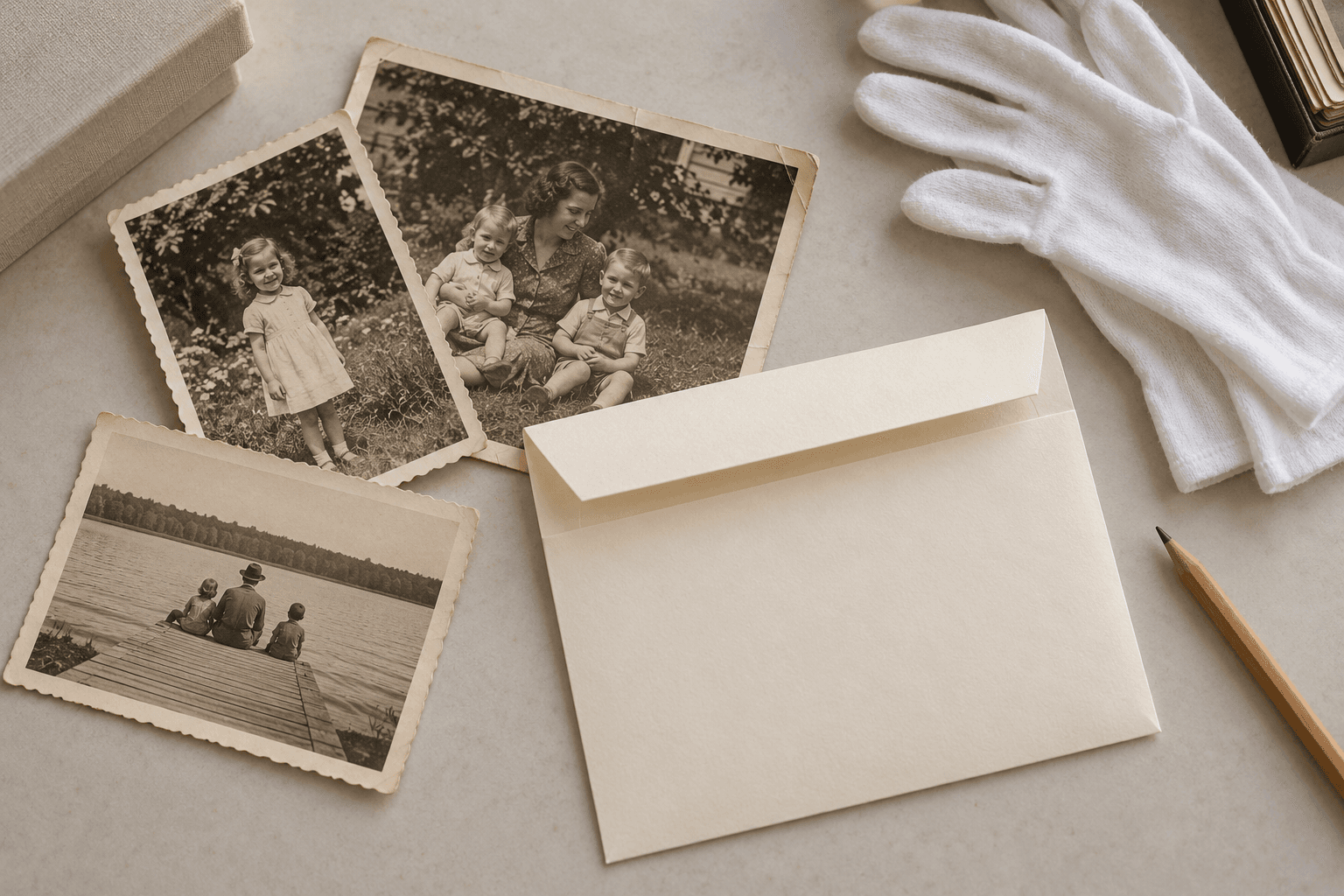
Establish an orientation reference
Look for readable writing, a studio mark, or another reliable directional clue in the source record. Note whether the repository already describes the image as reversed or rotated. Keep uncertainty explicit when the scene has no dependable reference. A person's apparent handedness is weaker evidence than a legible inscription and may be misleading. Save the exact view label and service reference so you do not compare a front scan with a different reproduction of the same portrait.
Inspect requested transformations
The IIIF Image API defines rotation and supports mirroring syntax where implemented. Review the actual request under the service's version and capability level. Record whether you changed rotation alone, a mirror operation, or another parameter at the same time. Request a modest sample within the service's limits and compare the result with the source. Do not assume every viewer's rotate button writes a corresponding permanent file; inspect the actual downloaded output and the route used to obtain it.
Label the accepted viewing version
Open the saved derivative outside the viewer and verify text direction, frame orientation, and important scene features. Put a transformation note with its filename and source ID. Retain the untouched download so a later researcher can reverse your reasoning without guessing. If a corrected orientation is used as an ImgHeal input, keep that preparation step in the derivative history. AI restoration does not establish which orientation was historically correct, and a generated inscription that looks readable is not a reliable substitute for the original directional evidence.
Check this workflow
- Choose a reliable directional reference.
- Record the actual service transformation.
- Inspect the downloaded file outside the viewer.
Sources and further reading
- IIIF: Image API 3Defines image-service requests, information responses, supported transformations, and limits.
Questions about this restoration task
Does a readable AI-generated sign prove the source was mirrored?
No. Generated writing can be altered. Base orientation decisions on the untouched source and reliable contextual evidence.
Continue with a related guide
Try a restoration on a copy of your photo
Keep the original scan. Upload a separate digital copy, review ImgHeal’s generated result, and decide whether it suits your needs.
Open ImgHeal