Can Shadows Help Test the Location of an Old Photograph?
By ImgHeal · Updated
Shadows can help test whether a proposed viewpoint is consistent with the photograph, but they do not usually identify a place or timestamp on their own. Record the likely light source, scene geometry, and uncertainties before comparing maps. Reversed copies, sloping ground, artificial lights, and unknown dates can make apparently precise shadow calculations misleading.
Explore this topic: Research photo evidence
Identify a reliable scene shadow
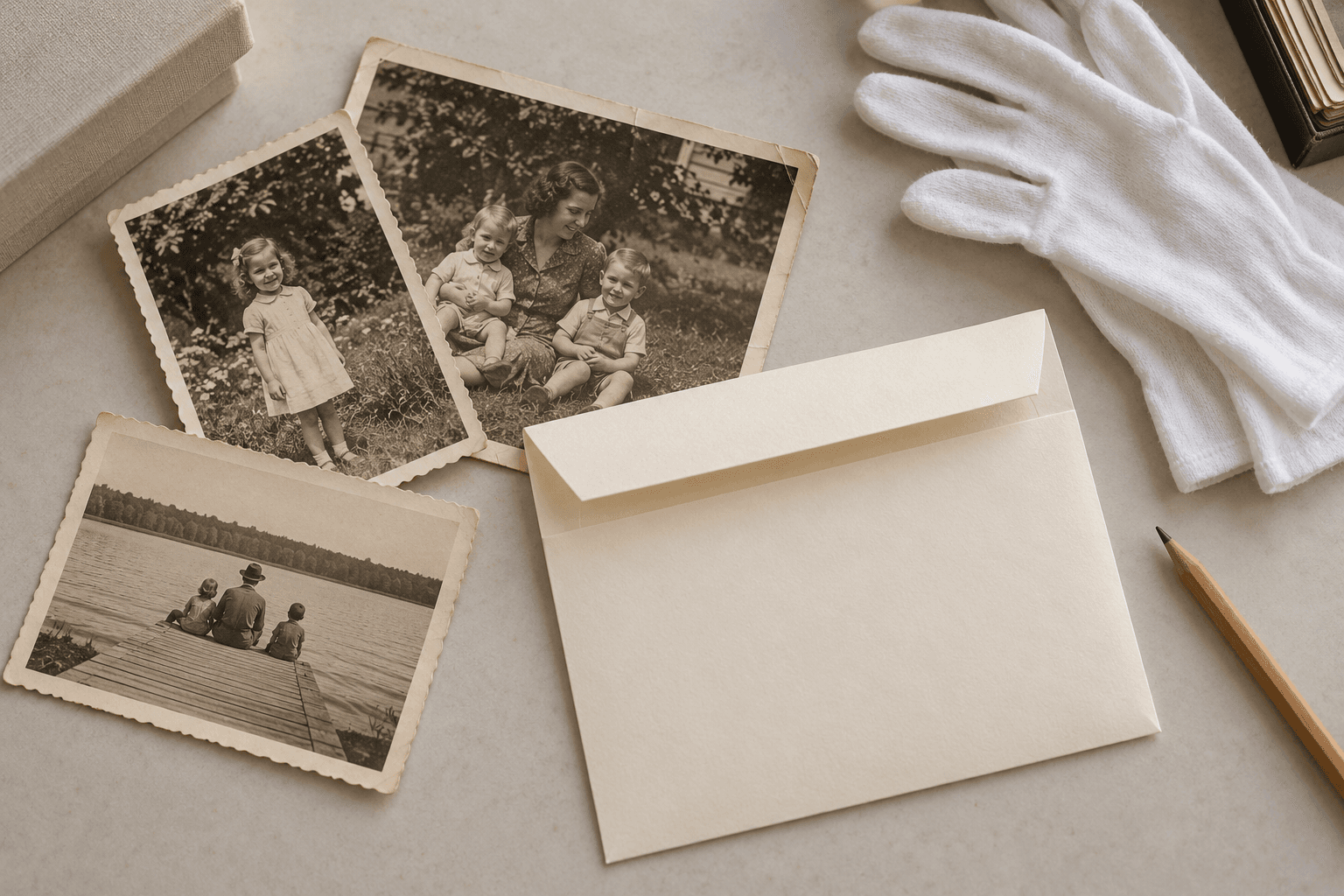
Choose a shadow connected to a visible object and a reasonably understood surface. Distinguish it from stains, reflections, and dark painted areas. Check whether multiple shadows share a coherent source and whether artificial lighting is possible. Use the untouched capture; restoration can alter a faint boundary or create an edge that makes a shadow appear longer or more definite than the original supports.
Compare a documented viewpoint
Locate fixed features on a suitable map and establish the candidate camera direction from more than one landmark. Keep north orientation explicit. Compare the general shadow relationship with that viewpoint, recording assumptions about ground slope and light direction. Do not use an exact-looking angle measured from a skewed scan as a precise physical measurement. A possible contradiction may also result from a reversed or perspective-distorted copy.
Use consistency rather than false precision
Record whether the shadow supports, conflicts with, or cannot distinguish the proposed location. Keep it alongside building, map, and provenance evidence rather than allowing it to override stronger sources. Leave date and time broad unless independently supported. If a calculation is later commissioned, provide the original image and all assumptions so a specialist can assess whether the geometry permits a meaningful result at all.
Before using this evidence
- The shadow and its object are identifiable.
- Viewpoint orientation has independent support.
- Assumptions and uncertainty accompany the conclusion.
Sources and further reading
- National Archives: Analyze a photographProvides an observation framework and asks which other evidence could answer questions raised by an image.
- USGS: topoViewIntroduces historical topographic map editions and tools for locating and downloading them.
Questions about this restoration task
Can a shadow alone give an exact exposure time?
Not reliably when date, place, geometry, and light source are unknown. Treat it as a consistency clue and avoid converting uncertain image measurements into a precise timestamp.
Continue with a related guide
Try a restoration on a copy of your photo
Keep the original scan. Upload a separate digital copy, review ImgHeal’s generated result, and decide whether it suits your needs.
Open ImgHeal